A customer wrote to us last month holding two cartridges up to her laptop camera, both labelled “1 micron,” both from different brands, both priced about $40 apart. She wanted to know which one actually worked. It’s a fair question, and one most people never get a straight answer to, because “1 micron” gets used as a marketing badge as often as it gets used as an engineering spec.
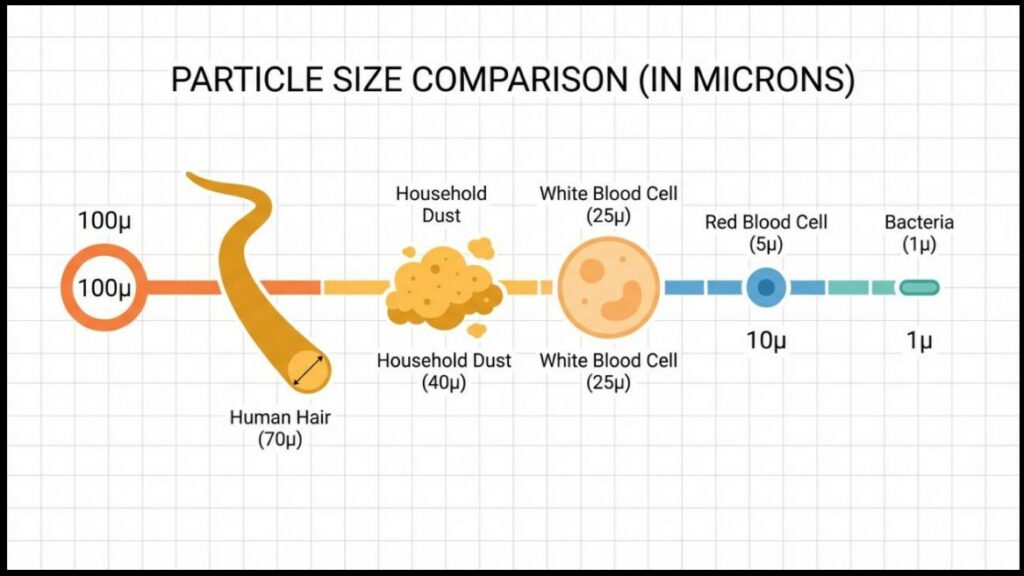
Here’s the plain English version. A micron is one millionth of a metre. A human hair is roughly 70 microns thick, so a 1 micron filter is catching particles about 70 times finer than something you can just see and feel. That’s fine as a starting point, but it doesn’t tell you what’s actually going through your tap. Two filters can both say “1 micron” and perform completely differently, and that gap is where people waste money.
Will a 1 micron filter reduce water pressure?
Yes, a little, and that’s not a flaw, it’s physics. Every filter creates resistance. The finer the rating, the more resistance, because the water has to work harder to squeeze through smaller gaps. A 1 micron filter will always restrict flow more than a 20 micron pre-filter.
The size of the drop depends on three things:
- Surface area. A slim benchtop cartridge has far less surface area than a full-size housing used in a house water filtration system, so the same micron rating feels far more restrictive in the smaller unit.
- Filter age. A fresh 1 micron filter flows better than one that’s six months into catching sediment. Once it’s loaded up the pressure drops.
- Staging. Most well-designed systems don’t ask a single 1 micron filter to do all the work. A 20 or 5 micron pre-filter strips out the bulk of the sediment first, so the 1 micron stage only has to catch what’s left. That single design choice is the difference between a system that chokes your morning shower and one you never think about.
If your water pressure drops noticeably after installing a filter, it’s almost never the micron rating itself. It’s usually an undersized housing or a filter that’s overdue for a change. Both are fixable without giving up on fine filtration.
Will a 1 micron water filter remove microplastics?
Partly, and the honest answer matters more than the reassuring one. Microplastics are generally defined as plastic fragments smaller than 5mm but larger than 1 micron, while nanoplastics are the smaller fraction below that. A 1 micron filter sits right at that boundary. It will catch the larger microplastic fragments in your water. It will not catch nanoplastics, and it won’t catch the smallest microplastic particles either.
To put a number on it, Columbia University researchers found that the average litre of bottled water contained around 240,000 detectable plastic fragments, and roughly 90 percent of those were nanoplastics, invisible even under a standard microscope. A 1 micron filter was never going to touch most of that. If nanoplastics specifically are what worries you, you need a membrane rated in the fraction of a micron, which is what a reverse osmosis water filter is built for.

Where a 1 micron filter earns its keep is with the bigger biological risks. The CDC notes that a properly rated 1 micron “absolute” filter will reliably remove Cryptosporidium oocysts, which sit around 4 to 6 microns, and Giardia cysts, which are larger again. Worth knowing: there’s a real difference between a “nominal” 1 micron filter and an “absolute” one. Nominal ratings are closer to an average, and some can let a fifth of the particles they’re rated for pass straight through. Absolute ratings are tested to a stricter standard, and it’s the wording worth hunting for on the box before you buy.
So the real question isn’t “will a 1 micron filter protect me.” It’s “protect me from what.” For everyday sediment, chlorine taste and the parasites that occasionally turn up in tank or town water, a good 1 micron stage in a countertop water filter or under-sink unit does the job well. For nanoplastics and the smallest dissolved contaminants, you’re looking at a finer membrane on top.
You don’t need to solve every micron at once. Work out what’s actually in your water, match the filter to that, and upgrade the parts that matter most first. A filter doesn’t need to catch everything to be worth having. It needs to catch what you’re actually exposed to.