
What is the clean air delivery rating?
When I first started looking into ways to make my home healthier, I was bombarded with acronyms. HEPA, VOCs, PM2.5… even though I knew what VOCs are from our journey into water filtration, it felt like I needed a science degree just to buy a fan!
But there is one acronym that actually matters more than almost any other when you are choosing an air purifier for your family. It’s called CADR.
If you’ve been browsing our shop or looking at specs, you might have seen this number tucked away in the “technical details” section. It usually looks something like “CADR 255m³/h.”
It’s easy to ignore, but you shouldn’t. In fact, understanding this number is the secret to knowing whether you are buying a machine that will truly protect your home, or just a white noise machine that looks pretty in the corner.
How is Clean Air Delivery Rate calculated?
CADR stands for Clean Air Delivery Rate.
Put simply, it is a score that tells you how fast an air purifier can clean the air in a specific size room.
Think of it like a race. If you have a room full of smoke, dust, or pollen, the CADR number tells you how quickly the machine can “scrub” that air clean compared to how fast the particles would naturally settle on their own.
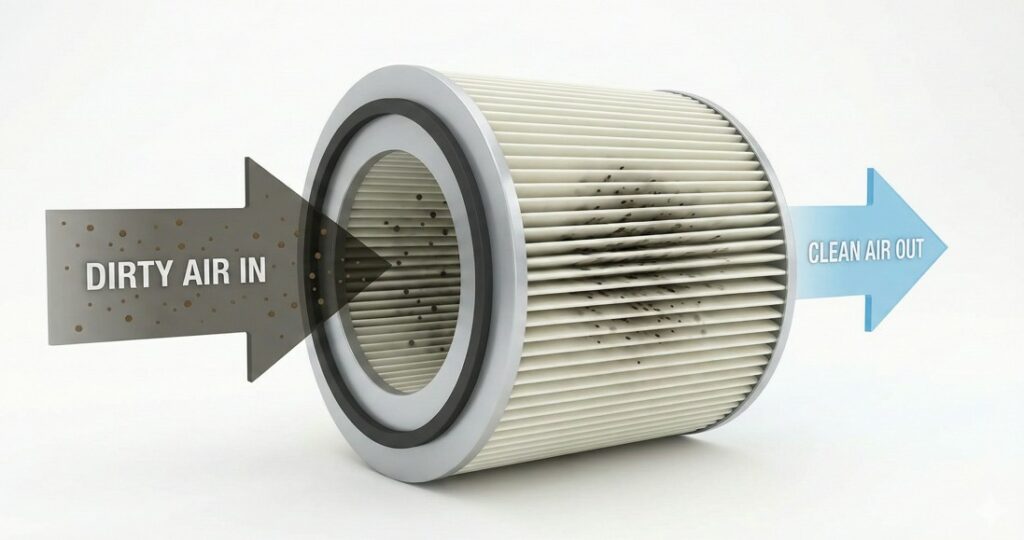
Technically, the rating is determined by independent laboratory tests (originally developed by the Association of Home Appliance Manufacturers). They place the unit in a sealed testing chamber and fill it with a specific amount of pollutants. They then measure how fast the unit removes those particles.
They usually test for three specific things:
1. Smoke (The smallest, hardest particles to catch)
2. Dust (Medium-sized particles)
3. Pollen (Larger particles)
This is why you might sometimes see three different numbers. An air purifier for dust might have a slightly higher score for dust than it does for smoke, because dust is easier to catch.
However, in Australia, we often simplify this into a single number representing the volume of clean air delivered per hour (m³/h).

Source: Visualcapitalist.com (www.visualcapitalist.com/visualizing-relative-size-of-particles)
The “Living Whole” Formula:
You don’t need to be a mathematician, but here is a simple way to visualize it. The CADR is basically the engine power of the machine.
- High CADR = A V8 engine. It cycles the air in the room very quickly.
- Low CADR = A scooter. It might eventually get there, but your family will be breathing in allergens for a lot longer while it tries to catch up.
Imagine a standard bedroom that is 3m x 3m with a normal ceiling height. That room holds about 22 cubic metres of air. If your air purifier is rated at 220 m³/h, it is strong enough to cycle through all the air in that bedroom 10 times every hour.
What is a good CADR value?
This is the most common question I get: “Is this a good number?”
The honest answer? It depends entirely on the size of your room. A “good” rating for a nursery might be terrible for an open-plan living room.
To figure out if a CADR is good for you, you need to look at Air Changes Per Hour (ACH).
For a home to feel like a true sanctuary—crisp, clean, and safe—you want your air purifier to filter the entire volume of air in the room at least 3 to 5 times every hour.
The “Rule of 12” (A Quick Trick)
Since we use meters in Australia, here is a very rough rule of thumb I use to help people choose the best air purifier:
Multiply your room size (in m²) by 12 (12 isn’t random; it is a shortcut that assumes you have a standard Australian ceiling height).
To help protect against allergies and smoke, experts recommend filtering all the air in a room at least 5 times per hour (about every 12 minutes) — based on guidance from the CDC and the Harvard Healthy Buildings Program. The Simple Math:
Take your room size in m2 and multiply it by 12.
• Room: 20m2
• Calculation: 20 x 12 = 240
• Result: You need a unit with a CADR of 240 m3/h.
If you look at a unit and the CADR is only 100m³/h, but you want to put it in a large lounge room, that machine will struggle. It will be like trying to empty a swimming pool with a teaspoon.
Why higher is usually better
I always suggest over-estimating rather than under-estimating.
If you buy a unit with a higher CADR than you need, you can run it on a lower, quieter speed (like “Sleep Mode”) and it will still clean the air effectively. If you buy a unit that is too small (low CADR), you will have to run it on “Turbo” all day just to make a dent in the dust, which is noisy and uses more energy.
How it all comes together
Don’t just look at the price tag or the aesthetic. Look at the CADR.
If you are fighting hay fever, living near a dusty road, or just want to ensure your children are sleeping in pristine air, a high CADR is your best friend. It’s the difference between hoping your air is clean, and knowing it is.
If you’re unsure which unit fits your room size, feel free to drop me a message with your room measurements—I’d love to help you do the maths!
Janka from Living Whole