
Last week, the parents of one of my son’s friends came to me asking for advice. They wanted to take charge of their health and asked if I could recommend a water filter that removes microplastics. However, they were on a tight budget and didn’t want to spend a lot of money, so I immediately started looking into basic, cost-effective replacement cartridges that efficiently trap microplastic particles. But as we kept talking, I realised I couldn’t just give them a quick fix without telling them the full story about nanoplastics.
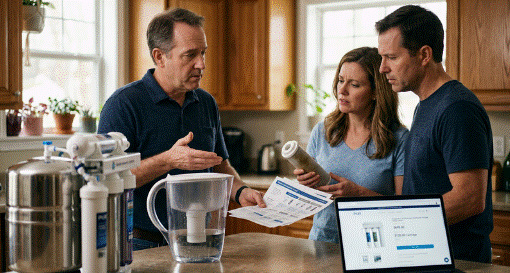
Removing standard microplastics is well and good, but to tackle the truly microscopic particles, a standard filter simply won’t cut it. You need a full reverse osmosis system. Admittedly, they weren’t thrilled to hear this. They are currently using a simple water pitcher filter, and upgrading to a comprehensive system costing over $800 felt like a massive, unexpected leap. But it got me thinking about how many families face this exact dilemma, staring down a steep price tag and wondering: can water filters remove nanoplastics, and is it truly worth it?
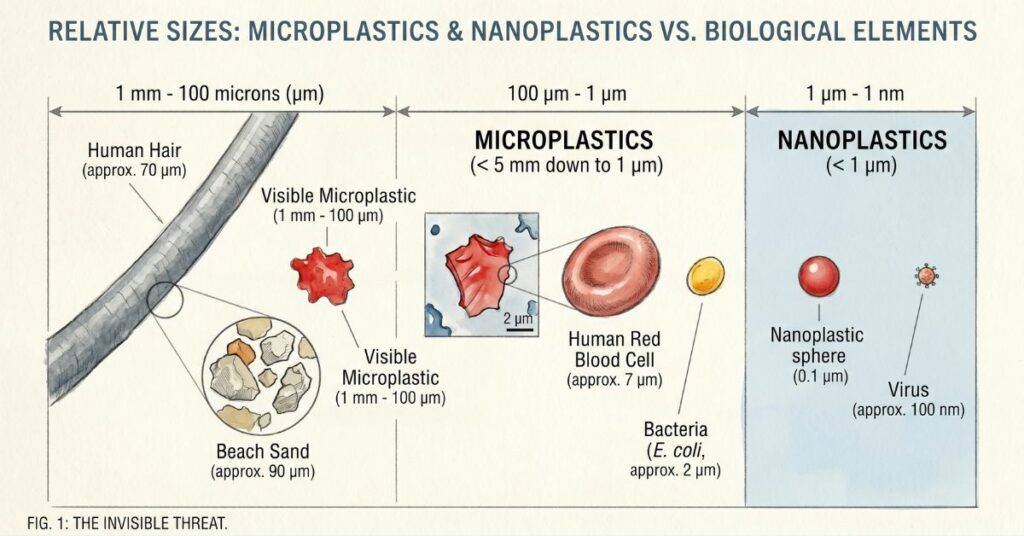
When you break down the science, the price jump starts to make sense. It all comes down to the sheer physics of scale. While microplastics range from 1 micrometer down to 5 millimetres, nanoplastics are defined as anything smaller than 1 micrometer. To put that in perspective, a single nanoplastic particle can be thousands of times smaller than a human red blood cell. Because they are so incredibly microscopic, the simple carbon filters in your everyday water pitcher have pores that are far too wide; nanoplastics just sail right through them. To stop them, we have to look toward more advanced, robust technology, prompting us to reframe the cost altogether. This isn’t an arbitrary expense; it’s a direct investment in your family’s long-term wellbeing.
How to remove nanoplastics from drinking water?
If you want to genuinely secure your home’s water supply against these tiny, invisible invaders, you have to look beyond the surface. To successfully remove nanoplastics from drinking water, you need a physical barrier with pore sizes that are significantly smaller than the nanoplastics themselves. This is where high-tier, specialised filtration enters the frame.
For anyone looking for a definitive, scientifically sound solution to this modern problem, my top recommendation is always reverse osmosis filtration. Reverse osmosis, or RO, is widely recognised as the gold standard in water purification for a reason. Instead of relying on a simple carbon block, an RO system uses high pressure to force water through a semi-permeable membrane with an exceptionally microscopic pore size – typically around 0.0005 microns.
Because nanoplastics are substantially larger than these incredibly tight pores, a reverse osmosis filtration system acts as an absolute wall. It successfully strips away these tiny plastic fragments alongside heavy metals, PFAS, and chemical residues that standard pitchers leave behind.
What water filter takes out microplastics?
When it comes to implementing this in your own home, you have a couple of excellent pathways depending on your space, budget, and setup.
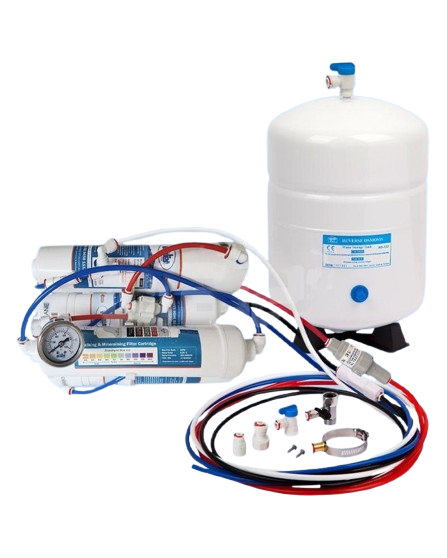
If your primary goal is to target your direct cooking and drinking water right at the kitchen tap, an undersink water purifier equipped with a multi-stage reverse osmosis system is your absolute best choice. These units sit discreetly beneath your kitchen counter, routing water through sediment blocks, carbon filters, and the crucial RO membrane before delivering pristine water through a dedicated faucet. It’s an incredibly reliable way to ensure that your daily hydration is completely free from synthetic debris.
On the other hand, if you want comprehensive peace of mind across your entire household, you might want to look into a comprehensive house water filter framework. While traditional whole-house sediment filters protect your appliances from rust and silt, integrating a specialised ultrafiltration ensures that the water you bathe in, wash your clothes with, and brush your teeth with is as pure as possible.
Choosing between a targeted undersink water purifier and a whole house water filter ultimately comes down to your household needs, but both represent an intentional, powerful line of defense against modern synthetic contaminants.
Ultimately, navigating our health in a plastic-filled world requires balancing practical budgets with modern tech. A high-quality system requires an upfront cost, and reframing it as a critical investment in your wellbeing changes everything. Knowing your water is truly pure provides invaluable peace of mind.